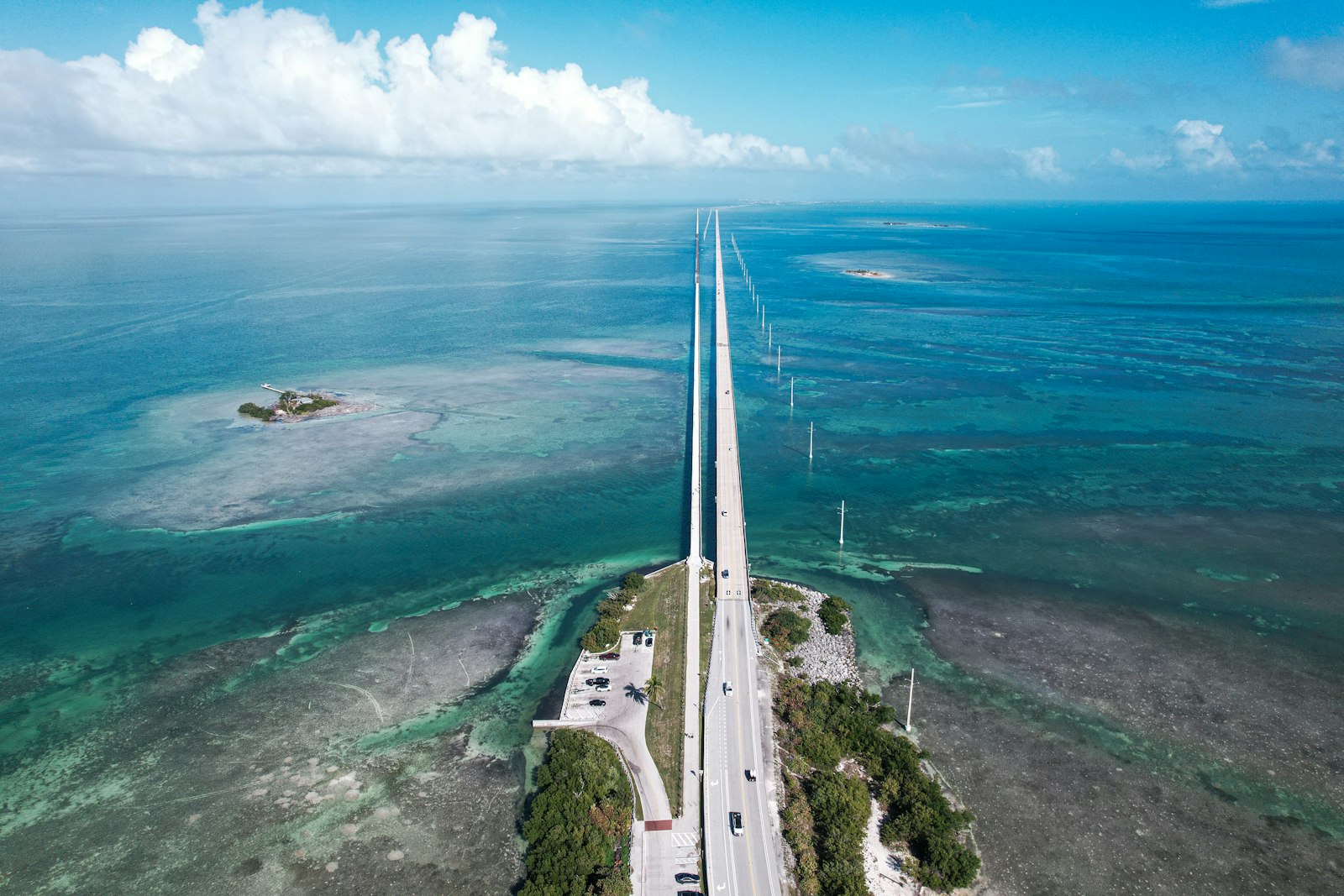
Go if you want turquoise water and the only living coral reef in the continental US — and you'll decide which Keys trip you're here for first.
01 — The Verdict
Go to the Keys. Just decide which Keys first — because there's one road, and it's more than a hundred miles long.
The Florida Keys look like a single place on the map: a curl of islands off the tip of Florida, strung together by one highway over the water.
In reality, they're a chain of very different trips. The islands are 100-plus miles apart on a single two-lane road, and the drive from the top to Mile 0 runs three-and-a-half to four hours.
A Key Largo trip and a Key West trip are almost different vacations.
Two more zones have their own trip entirely — and their own Meravella guide: Key Largo, the diving capital closest to Miami, and Islamorada, the sportfishing-and-dining "Village of Islands." This guide owns the rest of the chain: Marathon (the family-and-fishing middle), the quiet Lower Keys, and Key West at the end.
A Few Fits to Check First:
- It's one long road. US-1 — the Overseas Highway — is the only through-route: ~113 miles, mostly one lane each way, with drawbridges and seasonal traffic. Budget more time than the mileage suggests. Pick your zone and don't try to "do the whole chain" from a single base each day.
- Summer and fall are hurricane season. June through November, peak August–October, on the most hurricane-exposed coast in the country, with one evacuation road. Hurricane Irma (2017) forced multi-year rebuilds. A warm-season booking should carry travel insurance and a flexible-rate mindset — a real decision factor, not a footnote.
- It's pricey, and Key West is the priciest corner. Old Town lodging and dining run steep in winter high season. Marathon and the Lower Keys are the relative value stretch.
- Don't come for wide sandy beaches. The Keys are mostly mangrove-and-marina, not broad shore — the water is the draw, not the sand. The one real beach day is Bahia Honda.
- Outside Key West, you need a car. Key West's Old Town is walkable and bikeable (and you can fly into its own airport). Everywhere else is drive-to, resort-to-resort.
None of that is a reason not to go. It's the reason to decide which Keys first — so you're not paying Key West prices for a quiet trip, or hauling three hours south when the reef you came for was up north.
02 — Choose Your Keys
So don't start by asking, where should I stay? Start with: which Keys trip am I here for — and how far down the chain does it live?
- Laid-Back Couple. Island time, not a to-do list — a hammock, a beach or a pool by the water, sunset cocktails, and slowness.
- Diving & Fishing Adventurer. The water IS the trip — snorkeling and diving the only living coral barrier reef in the continental US, offshore and reef fishing, lobstering, a boat every day.
- Multigen Family. Space, a real pool (or five), easy logistics, and a base close to Miami so the drive with kids and grandparents is short.
- Party & Celebration Crew. Key West at full volume — Duval Street bars, Mallory Square at sunset, a milestone or a friends' weekend where the town IS the venue.
Same chain, same turquoise water — four completely different vacations. Get the which right and everything after it falls into place instead of fighting you — so you're not driving two hours for the wrong island. Pick yours, then step through the three doors below: what to do, where to stay, and where to eat.
Where to stay in The Florida Keys, FL
Our hotel picks are the verdict — this is just the lay of the land. Every stay on the map with live rates, so you can see what sits near what. Book whichever suits your trip.
Live map by Stay22 · rates from booking partners. We may earn a commission if you book through the map — it never changes which hotels we recommend.
When to Go, When to Book
Best months: December, January, March, and April — the dry-season sweet spot, with the caveat that these are also the busiest and priciest. Here's the honest shape of the year.
High season (December–April) — the best weather, and the crowds and prices to match.
Warm, dry, low-humidity, low-storm — this is why winter visitors come.
- Highs in the 70s to low-80s, breezier (and cooler) on cold-front days.
- The December holidays, Presidents' week, and March/April spring break are the peaks within the peak.
- Key West is at its most crowded and expensive.
Book lodging, charters, and the Dry Tortugas ferry well ahead.
The shoulder-value windows — May and November.
Warm, thinner crowds, softer rates — generally the best value-to-weather trade in the Keys.
May balances warmth and calm, clear reef water before summer's heat and storms set in; November settles into an excellent window after hurricane season winds down and before the holiday crush.
If your dates are flexible, these are the ones to target.
Summer and early fall (June–early December) — cheapest and quietest, with a real trade.
Hottest and most humid, highs in the upper-80s to 90s with near-daily afternoon thunderstorms — and the calmest, warmest, clearest water for diving between the storms.
Lowest prices, thinnest crowds. Go in with open eyes: this is hurricane season (below).
Two summer/fall spikes buck the low-season quiet:
- Lobster mini-season (the last consecutive Wednesday–Thursday of July) packs the Keys with divers.
- Fantasy Fest (late October, Key West) is a huge costumed-party surge — seek it or avoid it deliberately.
⚠ Hurricane season (June 1–November 30, peak August–October) — say it plainly.
The Keys are among the most hurricane-exposed places in the country — a narrow island chain with a single evacuation road.
Direct major hits aren't annual, but they're real and consequential: Hurricane Irma (September 2017) devastated the Middle and Lower Keys and forced multi-year resort rebuilds.
A summer or fall booking should carry travel insurance and a flexible-rate mindset, watch the forecast, and know that evacuations can close US-1. This is a genuine decision factor — but planned for, the value window is real.
⚠ Key West cruise-ship days — a separate thing to check.
When ships are in port, Old Town — Mallory Square, Duval, the Hemingway Home, the Southernmost Point — swells with day-trippers and lines lengthen, roughly mid-morning to late afternoon.
For a calmer Key West, target early morning and evening, and check the cruise-ship schedule for your dates.
The Real Version — Before You Book
The one-street-over truths, and the caveats we'd want a friend to know.
Pick your zone — you can't "do the whole chain" from one base each day.
This is the single most important thing to get right.
The Keys are 100-plus miles on one road, and the top and bottom are three-and-a-half to four hours apart. Key Largo, Marathon, and Key West are each a lovely base — but they're a real drive from one another.
So do one of two things: base in one zone and stay mostly in it, or plan a drive — a one-way run down the chain with a night or two along the way.
A trip that tries to reach everything from a single hotel every day will spend the vacation in the car.
Budget more time than the mileage suggests.
US-1 is the only through-road: mostly one lane each way, with drawbridges and seasonal traffic, worst on Friday and Sunday in high season and behind any crash or bridge opening.
Within Key West, walk, bike, pedicab, or take the Conch Tour Train or Old Town Trolley — Old Town parking is tight and paid. Rideshare is available but thin outside Key West.
Confirm current drive times and conditions live before you rely on them.
Two gateways — and a shortcut if Key West is the whole trip.
Miami International (MIA) is the main gateway — about an hour to Key Largo, but three-and-a-half to four hours all the way down to Key West. Fort Lauderdale (FLL) is a similar-or-slightly-longer haul.
If Key West is your entire trip, fly into Key West International (EYW) and skip the long drive — Old Town is walkable and you may not need a car at all. The trade: it's a smaller airport with fewer, often pricier flights.
Confirm current drive times and flight options live — they move.
Don't come for the beach; come for the water.
Say it plainly: the Keys are mostly mangrove-and-marina, not wide sandy shore. Even the resort "beaches" are often engineered or modest by mainland-Florida standards.
The trade is what's in the water — the only living coral barrier reef in the continental US, a few miles offshore the length of the chain, turquoise shallows dropping to deep blue at the reef line.
For a genuine sand day, that's Bahia Honda in the Lower Keys — the rare real beach, and worth planning around.
And the money truth.
The Keys are a high-cost destination, and Key West is the priciest corner — Old Town lodging and dining run steep in winter high season.
- Marathon and the Lower Keys are the relative value zones.
- Fishing charters and the Dry Tortugas ferry are significant add-on costs (the ferry alone runs around $250 a person).
- Rates swing hard by season: winter is the peak, May and November are the value windows.
Some places close or cut back seasonally, too — confirm hours before you build a day around one. Every price band in this guide is research-derived and gets a dated live-rate re-check before anything you'd act on.
FAQ — The 11pm Questions, Answered
Which Keys should I stay in? Decide by your trip, not the map — that's the spine of this whole guide, laid out in The Verdict and Choose Your Keys above (then the full picks live on Where to Stay). The one-line rule: pick the Keys you're here for, and don't pay Key West prices for a quiet trip, or haul three hours south when the reef you came for is up north.
How many days do I need? Four to five is the sweet spot — enough to drive a good stretch of the chain, get on the water, do a beach day at Bahia Honda, and give Key West a real day or two, without living in the car.
Three works if you commit to one zone. Add days if you want to run the whole chain, Key Largo to Key West, since the ends are three-plus hours apart.
When's the best time to visit? December through April is the dry-season sweet spot — the best weather, and the biggest crowds and prices.
May and November are the softer value windows. Summer and early fall are cheapest and quietest, with heat, near-daily storms, and hurricane-season trade-offs.
Do I need a car in the Keys? Almost always yes.
Outside Key West, the Keys are car-dependent — one road, everything spread along it, resort to resort.
The exception: a Key-West-only trip. Fly into EYW, and Old Town is walkable and bikeable, so you can skip the car entirely.
Are the Keys expensive? Yes — a high-cost destination, with Key West the priciest corner, especially Old Town in winter high season.
Marathon and the Lower Keys are the relative value zones. And remember the add-ons: fishing charters and the Dry Tortugas ferry (around $250 a person) run separately.
What's the deal with hurricane season? June 1 to November 30, peak August through October, on the most hurricane-exposed coast in the country, with one evacuation road.
Direct major hits aren't annual, but they're real (Hurricane Irma, 2017). A summer or fall booking should carry travel insurance and a flexible-rate mindset, and watch the forecast — evacuations can close US-1.
Where's the actual beach? Bahia Honda State Park, in the Lower Keys — widely called the best natural beach in the chain, and a genuine rarity here. Arrive in the morning; the parking lot fills early on weekends and in high season.
The rest of the Keys are more mangrove-and-marina than sand — the water and the reef are the draw, not the shore.
Which reef should I snorkel — and where from? Do the one near your base. Looe Key, in the Lower Keys, is the premier reef down south — a short boat trip from Big Pine/Ramrod. John Pennekamp, up in Key Largo, is the Upper-Keys reef. Both are boat trips in open water, so pick a calm morning and a reputable charter — the full read is on What to Do.
Is Key West worth the long drive? For a first Keys trip, yes — it's the cultural, nightlife, and history capital, and the end-of-the-road payoff is real. Just know it's the busiest and priciest zone, worst on cruise-ship days.
If Key West is your whole plan, fly into EYW and skip the drive; if it's one stop on a chain-long trip, save it for the finale.
Basis: the Keys firsthand — we've been to Key West and Islamorada. Last verified 2026-08-17. Prices are bands, re-checked before you'd act. We never rank by commission. (Lodging and dining basis notes live on the Where to Stay and Where to Eat pages.)
Make The Florida Keys yours
Save this decision to your Travel Home — your trips, your picks, and everything you’re planning in one place. We’ll keep it current as prices and seasons move.