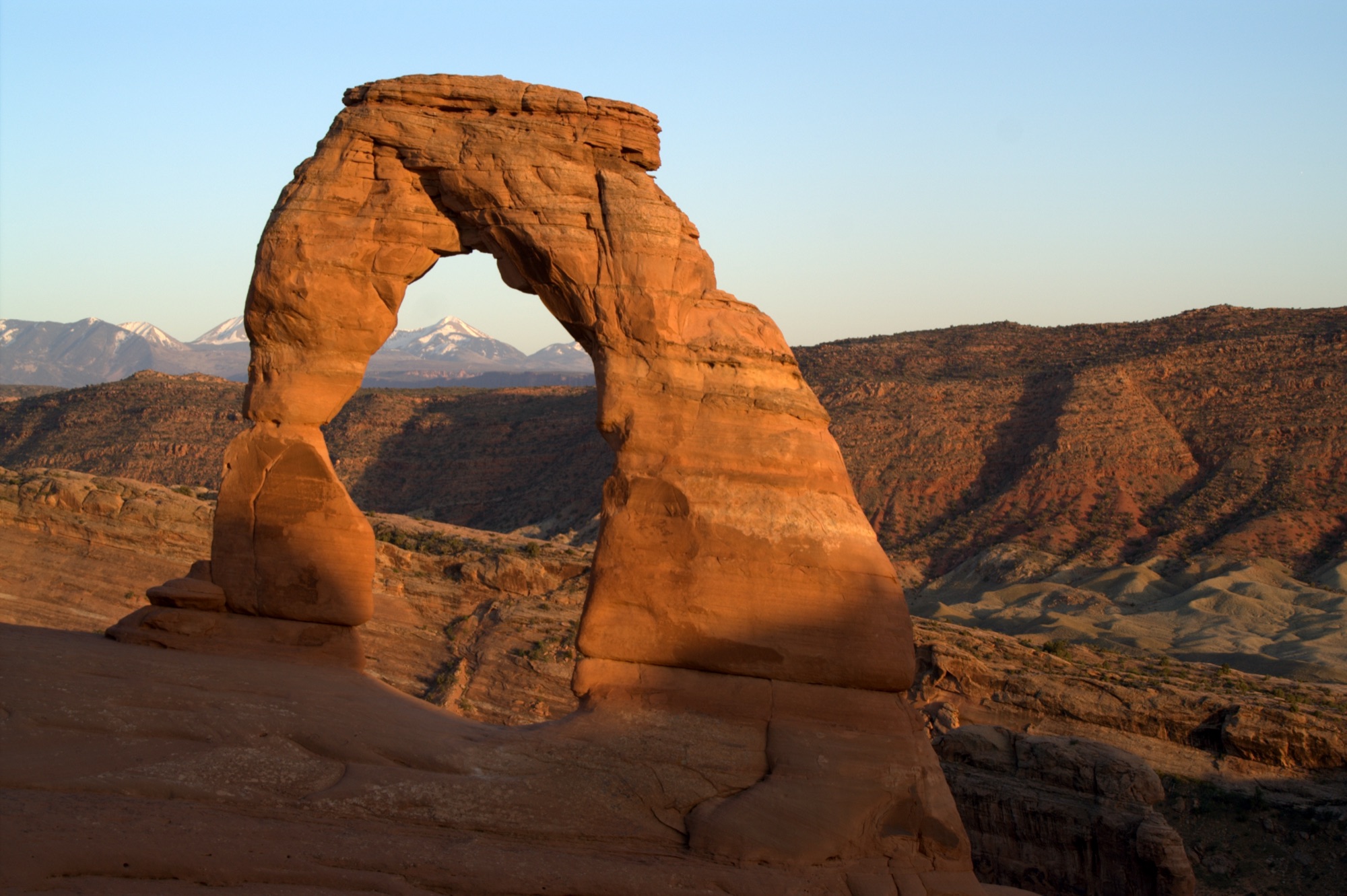
Go if you want the red-rock greatest hits from one basecamp town — Arches' Delicate Arch and the Windows, Canyonlands' Mesa Arch at sunrise and Grand View Point, Dead Horse Point at sunset, plus a wall of mountain biking, 4x4, and river days.
01 — The Verdict
Go to Moab. The real question is which version of the desert you came for.
Two national parks. A river. Slickrock. 4x4 trails. Dark skies. And enough ways to experience them that two people can visit Moab in the same week and come home with completely different trips.
Moab is a small desert town that happens to sit between two of the great national parks in the country: Arches, about five miles north, all balanced rocks and stone spans; and Canyonlands' Island in the Sky, a forty-minute drive to a mesa a thousand feet above the canyons. Add Dead Horse Point, a wall of world-famous mountain biking and 4x4 slickrock, and the Colorado River running right past town, and you have one basecamp pointed at four very different trips.
The red rock is the same for everyone. The trip is not — the icons at a family's pace, the slickrock and Jeep trails for an adventure crew, dawn hikes and quiet for a couple, the big views by car for a group that's done climbing. Same town, four completely different vacations.
A Few Fits to Check First:
- You need a car — this is a drive-everywhere desert. Only Main Street is walkable. Arches is a ten-minute drive, Island in the Sky and Dead Horse Point are about forty minutes, the Needles is an hour and a half, and every trailhead and river put-in is a drive. A 4x4 rental is its own category for the Jeep trails.
- Summer is dangerous heat, not just hot. June through August, highs routinely top 100°F with almost no shade on the trails, and rangers pull people off exposed hikes in the afternoon. A summer trip becomes a dawn-and-dusk trip.
- For 2026, Arches has no timed-entry reservation — a change from recent years — so you can drive in any time with a valid pass. But the entrance line and the trailhead lots still fill on peak mornings, so arrive at or before sunrise. (This policy has flipped before; check the current-year rule before you go.)
- The fees stack, and the parks are cashless. Arches and Canyonlands are each $30 per vehicle for seven days (or one $80 America the Beautiful pass covers both), card only. Dead Horse Point is a separate $20-per-vehicle state-park fee that no national-park pass covers.
None of that is a reason not to go. It's the reason to decide which Moab is yours first — so everything after it (what to do, where to base, where to eat) falls into place instead of fighting you.
02 — Choose Your Moab
Start with who's going and what you came to do — the base, the meals, and the rest follow from there, not the other way around.
- First-Timer Two-Parks Family. The red-rock greatest hits over a few days without overreaching — Arches' Windows Section and Delicate Arch viewpoint, the big overlooks at Canyonlands' Island in…
- Adventure Basecamp (Bike & 4x4). Moab as the point — the Slickrock Bike Trail and the Sand Flats, the Whole Enchilada if legs and shuttles allow, Hell's Revenge and the Shafer switchbacks in a…
- Red-Rock Hiking Couple. Trailheads at first light and the payoff to themselves — Delicate Arch for sunrise or sunset, Devils Garden out to Landscape Arch and the primitive loop, Mesa…
- Scenic-Drives & Easy-Walks Multigen Group. The red rock by car and short walk, at an easy pace, for a group spanning generations — the paved scenic drives through Arches and out to Grand View Point, the…
Same slickrock, same impossible red-rock light — four completely different trips. Pick yours, then step through the three doors below: what to do, where to base, and where to eat.
Where to stay in Moab, UT
Our hotel picks are the verdict — this is just the lay of the land. Every stay on the map with live rates, so you can see what sits near what. Book whichever suits your trip.
Live map by Stay22 · rates from booking partners. We may earn a commission if you book through the map — it never changes which hotels we recommend.
When to Go, When to Book
Best months: April, May, September, and October — the desert's two sweet spots, warm days and cool nights, on either side of a summer you want to plan around.
Spring (April–May) — prime, and the busiest stretch of the year. Warm days, cool nights, wildflowers, and the desert at its most comfortable — which is exactly why everyone comes. Easter week brings the Jeep Safari and spring break brings the crowds, so lodging books months ahead. The rivers also run highest now with snowmelt.
Fall (mid-September–October) — the other sweet spot, and many locals' favorite. Days ease back into the 70s and 80s, nights cool off, the cottonwoods turn gold, and the crowds thin from the spring peak. Prime hiking and biking weather — the window we'd pick if forced to choose one.
Summer (June–August) — cheaper and quieter, for a serious reason. Say it plainly: this is dangerous heat. Highs routinely top 100°F with almost no shade, and rangers pull people off exposed hikes in the afternoon. It works only as a dawn-and-dusk trip, and late summer adds monsoon flash-flood risk in the slot canyons. Lower crowds and rates, in exchange for planning your whole day around the sun.
Winter (November–March) — quiet, cheap, and starkly beautiful. The calmest and most affordable season — cold, short days, and the occasional dusting of snow on the red rock. The parks stay open, but some things close: seasonal lodges and tour operators shut for the winter, and a few restaurants go dark.
Booking notes.
- Spring and Easter Jeep Safari book far ahead. If your dates land on the Safari or a festival weekend, reserve months out or expect a very different — busier, pricier — town.
- Fiery Furnace and Devils Garden Campground need reservations. The Fiery Furnace ranger-led tickets release up to six months ahead and sell out.
- Re-verify the Arches entry policy for your travel year. For 2026 there's no timed-entry reservation, but that has flipped before — check the current rule before you go.
The Real Version — Before You Book
The one-street-over truths — the caveats we'd want a friend to know before booking.
A car isn't optional here. Only Main Street is walkable. The parks, the overlooks, the trailheads, and the river are all a drive — Arches ten minutes, Island in the Sky and Dead Horse Point about forty, the Needles ninety. The one car-light way to do it is to base walkably in town and book a guided tour or shuttle for each day's activity.
The heat is the real hazard, not the crowds. In summer, treat every exposed trail as a dawn-or-dusk activity, carry far more water than feels necessary (a liter per person per hour on the trail), and turn around if you're running late into the midday sun. This is the thing first-timers underestimate most.
Arches in 2026: no reservation, but arrive early anyway. The park dropped its advance timed-entry reservation, so you can enter any time with a valid pass. But the entrance line and the trailhead lots still fill on peak mornings. The fix is the same as it always was: be there at or before sunrise. And re-verify the policy for your year — it has reversed before.
Some of the marquee adventures are expert-only — respect that. The Slickrock Bike Trail and Hell's Revenge are genuinely advanced — steep, exposed slickrock with real consequences, not beginner outings. If you don't have the rig or the experience for the 4x4 routes, book a guided Jeep or UTV tour.
Some things close for winter — check your dates. Roughly November through February, seasonal lodges, a few restaurants, and some river and tour operators shut down, so confirm anything you're building a day around against your travel dates.
FAQ — The 11pm Questions, Answered
Do I need a reservation to get into Arches? For 2026, no — the park dropped its advance timed-entry reservation, so you can enter any time with a valid pass. But the entrance line and the trailhead lots still fill on peak mornings, so arrive at or before sunrise. Two things still need a reservation: the Fiery Furnace and the Devils Garden Campground. Check the current-year rule before you go — this policy has flipped before.
Do I need a car in Moab? Effectively yes. Only Main Street is walkable; the parks, overlooks, trailheads, and river are all a drive. The one car-light option is to base in town and book a guided tour or shuttle for each activity.
How many days do I need? Two full days covers the greatest hits — one for Arches, one for Canyonlands' Island in the Sky and Dead Horse Point. Add a third for a river day, the biking or 4x4 trails, or the quieter Needles district an hour and a half south.
Arches or Canyonlands — which one? Do both; they're different trips. Arches is the up-close one — stone spans and balanced rocks on short-to-moderate trails, five minutes from town. Canyonlands' Island in the Sky is the grand-overlook one — a mesa a thousand feet up, forty minutes out, with Mesa Arch at sunrise and Grand View Point.
Is it too hot in summer? It's genuinely dangerous heat, June through August — routinely over 100°F with almost no shade. It's doable only as a dawn-and-dusk trip, and carry a lot of water. Spring and fall are far more comfortable.
Is Moab good with kids and grandparents? Yes, if you lean on the easy payoffs — the Windows Section in Arches, the drive-up overlooks at Island in the Sky and Dead Horse Point, a scenic river float, and short walks. Keep the heat and sun front of mind, plan mornings, and carry water.
How much are the park fees? Arches and Canyonlands are each $30 per vehicle for seven days, or one $80 America the Beautiful pass covers both — and both parks are cashless. Dead Horse Point State Park is a separate $20-per-vehicle fee that no national-park pass covers.
Basis: Moab firsthand — we've camped here and hiked Arches and Canyonlands. Last verified 2026-08-19. One thing to re-check every year: the Arches entry policy (it has flipped before). Prices are bands, re-checked before you'd act. We never rank by commission. (Lodging and dining basis notes live on the Where to Stay and Where to Eat pages.)
Make Moab yours
Save this decision to your Travel Home — your trips, your picks, and everything you’re planning in one place. We’ll keep it current as prices and seasons move.